
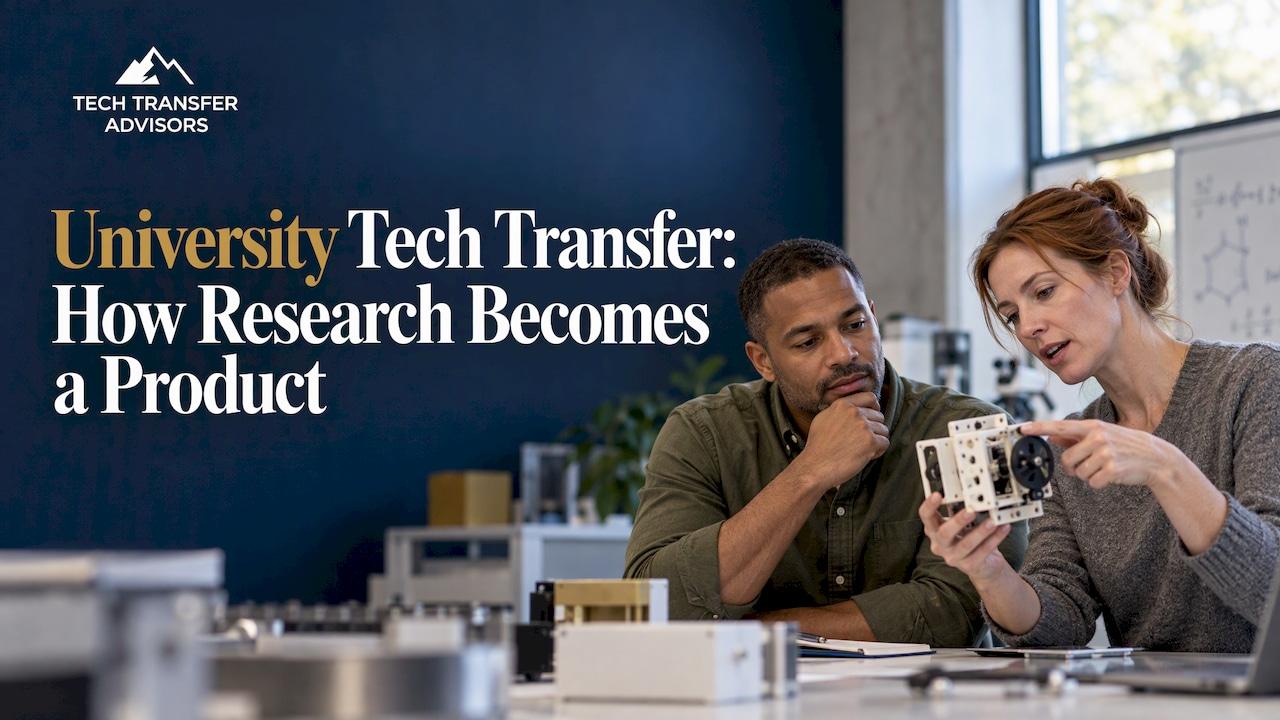
University tech transfer is the formal process of moving discoveries made in academic labs to companies that can develop them into products or services. In the U.S., a campus technology transfer office (TTO) usually handles it: the researcher discloses an invention, the office evaluates and protects it, and the university either licenses it to an existing company or helps launch a startup around it. This guide walks through each step, who owns what, how licensing and spinouts differ, and what funding and outside support can speed things up.
TL;DR
- Tech transfer moves technology from universities and research institutions to industry, per the USPTO, where it can become a commercial product or service.
- Under Bayh-Dole, universities can hold title to inventions from federally funded research and license them to industry.
- The two main routes are licensing to an established company or forming a startup, and nearly all startup licenses are exclusive.
- Disclose before you publish or present: U.S. patent filing is tied to a one-year window after public disclosure, and most other countries have no such grace period.
- Non-dilutive funding such as SBIR/STTR can carry a project past the lab stage. Outside advisors can help with strategy, licensing terms and investor access.
Table of Contents
- What university tech transfer actually is
- Who owns a university invention: Bayh-Dole
- What a tech transfer office does
- From lab bench to license: the disclosure process
- Licensing versus a startup: choosing a path
- Funding the gap between discovery and product
- How to judge tech transfer results
- Preparing before you disclose
- Our perspective
- Support when your office needs more capacity
- FAQ
- Sources
What university tech transfer actually is
A university produces knowledge. A company produces and sells products. Tech transfer is the bridge: the legal, commercial and practical work that lets a finding made in a lab reach people who can use it.
The USPTO describes technology transfer as the movement of technology from universities and other research institutions to industry, where it can be developed into a commercial product or service. Most of the time the vehicle is intellectual property: a patent application, copyrighted software, a biological material, or know-how, which the university then licenses.
The work is not only administrative. Someone has to judge whether an invention has a market, decide whether a patent is worth the cost, find a licensee or a founding team, and negotiate terms that work for a nonprofit institution and a for-profit partner at the same time. That is why the field has its own professionals, offices and vocabulary.

Who owns a university invention: Bayh-Dole
Before 1980, the federal government generally held rights to inventions made with its money, and few were ever developed. The Bayh-Dole Act changed that. According to the USPTO, it allows universities and other institutions to hold title to patents on inventions stemming from federally funded research and to license those rights to industry partners.
The law comes with obligations. As Stanford's licensing office explains, universities must:
- grant the U.S. government a royalty-free license for governmental purposes;
- give preference to U.S. manufacturers and to small businesses;
- share royalties with the inventors.
The statute is codified at 35 U.S.C. §§ 200-212. A practitioner overview from Ropes & Gray reports that licensing of academic IP since its passage has produced more than 11,000 startups, more than 4.2 million jobs and more than $1.3 trillion in U.S. economic growth.
In practice, ownership also depends on your institution's own IP policy and on any sponsor agreements. If your work touched federal money, industry sponsorship or a collaborator at another institution, read those documents before you talk to anyone outside the university.
What a tech transfer office does
A TTO sits between researchers and the market. Typical responsibilities, drawn from university offices' own published guidance:
- Intake and evaluation. Researchers report inventions that may have commercial or public value. The office analyzes the potential market, assesses patentability and evaluates commercialization strategies.
- Protection. Filing patents and managing other IP rights.
- Agreements. Drafting and negotiating licenses, plus the paperwork that protects materials and confidential information, such as Material Transfer Agreements and Non-Disclosure Agreements.
- Marketing. Finding companies that might license the technology.
- Startup support. Some offices offer startup-friendly terms. The SDSU office, for example, describes deferred patent expenses and reasonable royalty rates for faculty startups, with net royalties split 50-50 between the creators and the university.
Royalty splits and startup terms vary by institution, so check your own university's policy rather than assuming these figures apply.
From lab bench to license: the disclosure process
The process starts with an invention disclosure. The steps below are common across U.S. universities, though forms and timelines differ.
- Submit an invention disclosure. Describe what you made, how it works, who contributed, and what funding supported it.
- Office review. The TTO studies the market and patentability, then decides whether to protect and pursue the invention.
- Protect. If it proceeds, the university typically files a patent application, often a provisional one first.
- Market and negotiate. The office approaches existing companies or supports a founder team.
- License or spin out. A signed agreement transfers defined rights, and royalties flow back to the university and inventors.
Timing matters more than anything else here. Case Western Reserve's inventor guidebook advises submitting a disclosure well before any public disclosure. In the U.S., patents must be filed within one year of public disclosure, while in most other countries they must be filed before it. A conference abstract, a thesis posting or a talk can close doors abroad before you realize it.
Licensing versus a startup: choosing a path
Most inventions end up on one of two paths, and the choice shapes everything after.
| Licensing to an established company | Forming a startup | |
|---|---|---|
| Who develops it | An existing company with manufacturing and sales | A new company built around the invention |
| Capital needed | Mostly the licensee's | Substantial: R&D, production, marketing, operations |
| Typical income | Upfront payments, ongoing royalties, or both | Equity value if the company succeeds |
| Inventor's role | Often advisory | Often a founder, advisor or scientific lead |
| Speed and risk | Depends on the licensee's priorities | Higher risk and more control |
The descriptions come from IP Guardian Law's comparison: licensing grants permission to use, produce or sell an invention while the patent holder keeps ownership, while startup commercialization means creating a company that needs capital from sources such as venture capitalists, angel investors or crowdfunding.
The startup route usually involves an exclusive license. UC Berkeley's startup guide notes that nearly all startup IP licenses are exclusive, which encourages investment in high-risk R&D and rewards entrepreneurs for their commitment. The same guide explains that a U.S. patent gives its owner a limited 20-year period to exclude others from making, using, selling and importing the patented invention. That clock is part of what makes exclusivity valuable, and part of why timing and prosecution strategy matter.
Academic licenses also read differently from commercial ones. Universities face legal constraints under Bayh-Dole and tax rules tied to their nonprofit status, so their license structures can look unusual to lawyers used to ordinary commercial IP deals. Founders who understand those constraints negotiate better.
Funding the gap between discovery and product
The hardest stretch is usually between a promising result and a product an investor will back. Federal programs are built for it, especially in health and life sciences.
SBIR and STTR
According to NIA's small business FAQ (updated April 2026):
- NIH SBIR/STTR Phase I supports prototype feasibility, usually for up to one year, with awards up to $300,000 (or $500,000 for Alzheimer's disease and related dementias research).
- Phase II funds additional prototype R&D, generally for two years, with awards up to $2 million (or $2.5 million for Alzheimer's and related dementias).
- Phase IIB supports additional R&D toward commercialization.
STTR is the program built for university collaboration. The NIH Grants Policy Statement says both phases require the small business to partner formally with a single nonprofit research institution, with at least 40 percent of the research done by the small business and at least 30 percent by the research institution. Award limits and rules are updated periodically, so confirm them on the agency pages before you plan a budget.
Later-stage and training programs
- The NIH Commercialization Readiness Pilot supports later-stage R&D and technical assistance for small businesses with an active SBIR or STTR Phase II or IIB award within the last 36 months.
- NIA reports that this program's technical assistance can cover regulatory strategy, FDA submissions, IP strategy, manufacturing and GMP compliance.
- NIH has built a network of 11 hubs and centers for academic innovators at the early stage of product development, offering entrepreneurial training, expert feedback and project management support.
- NIBIB's C3i program has provided mentored business training to over 220 teams since 2014, and reports those teams have received over $120M in SBIR/STTR funding and launched over 40 products.
If your technology is a device or therapeutic, regulatory planning belongs in the same conversation as funding. Our guides on medical device regulatory strategy and FDA regulatory consulting cover what to settle early.
How to judge tech transfer results
The numbers that get quoted are licenses signed, startups formed and revenue earned. They are useful but incomplete. Impact can be tangible or intangible, short- or long-term, direct or indirect, so measuring it is complex.
Performance also varies widely between institutions. An analysis of AUTM licensing survey data found that the top 20% of institutions contribute over 60% of total commercialization activity, suggesting untapped potential at many other research organizations.

That gap is practical news for researchers and smaller institutions. Results depend less on the size of a lab's budget than on how early an invention is evaluated, how well it is protected and how well it is matched with a market. Those are all things a team can improve with a deliberate process.
Preparing before you disclose
A few habits make every later step easier:
- Keep dated records of who contributed what, and of funding sources.
- Hold back public details until the disclosure is filed.
- Learn the market early. A short assessment of who would buy the technology and why saves months. Our guide to biotech market research shows how to size and validate a market.
- Check freedom to operate. Owning a patent does not mean you can sell the product without infringing someone else's. See our explanation of freedom to operate analysis.
- Map the path to the clinic or customer. Our overview of life science commercialization lays out the stages.
Our perspective
Most promising inventions do not stall because the science is weak. They stall because nobody did the commercial work early enough: a market view, a patent strategy tied to a real buyer, a license structured for the company that will carry it forward.
Our team has worked inside major university technology transfer offices, led startups, reviewed federal grants and commercialized technology for industry. That mix shapes how we advise. We look at an invention from the researcher's side, the university's side and the investor's side at once, because a deal only closes when all three can accept it.
We build tailored strategies, not templates: IP and licensing structure, spinout formation, go-to-market planning, funding strategy including SBIR/STTR, and introductions to investors and industry. Legal work is coordinated with a dedicated IP law partner, so strategy and legal execution move together.
the author
Support when your office needs more capacity
Campus offices handle large portfolios, and researchers and founders often want a second set of experienced eyes. Tech Transfer Advisors works with universities, researchers, founders and companies on IP and patent strategy, licensing agreement structuring, spinout formation, life sciences and medical device commercialization, engineering technology transfer, go-to-market planning, investor introductions, SBIR/STTR funding strategy, market assessments and technology scouting.

See how an engagement could work on our services page, or start from Tech Transfer Advisors to describe your technology.
FAQ
Does the university always own my invention?
Not always, but often. For federally funded work, Bayh-Dole lets the university hold title, and most university policies assign inventions made in the course of employment to the institution. Sponsor agreements and collaborations can change the picture, so read your institution's IP policy and funding terms.
Do inventors get paid when a university licenses their work?
Usually, yes. Bayh-Dole requires universities to share royalties with inventors, and the split is set by each institution. SDSU, for example, publishes a 50-50 split of net royalties between creators and the university.
When should I contact the tech transfer office?
Before you publish, present or post anything about the invention. U.S. patents must be filed within one year of public disclosure, and most other countries require filing before disclosure, so an early disclosure form protects your options.
Should I license my technology or start a company?
License when an established company can develop and sell it with its own capital and channels. Start a company when you want control and can attract funding. Startups usually take an exclusive license, and grants such as SBIR/STTR can help fund the early work.
Sources
- Technology Transfer, USPTO
- Stanford Policies on Intellectual Property, Office of Technology Licensing
- Key Negotiating Points in Academic IP Licenses, Ropes & Gray
- Commercialization Process, University of Minnesota
- Commercialization Pathways, University of South Carolina
- Commercialization Pathways, SDSU Technology Transfer Office
- Technology Transfer Office Inventor's Guidebook, Case Western Reserve University
- Contrasting patent licensing with self commercialisation, IP Guardian Law
- Entrepreneurs' guide, UC Berkeley IPIRA
- NIA Small Business Programs FAQ
- NIH Grants Policy Statement 18.5
- Commercialization Readiness Program (SB1), NIH
- Academic Entrepreneurship and Product Development Programs, NIH SEED
- Concept to Clinic: Commercializing Innovation (C3i), NIBIB
- Evaluating disparities in the U.S. technology transfer ecosystem, PMC
- Measuring the impacts of university-industry R&D, Springer